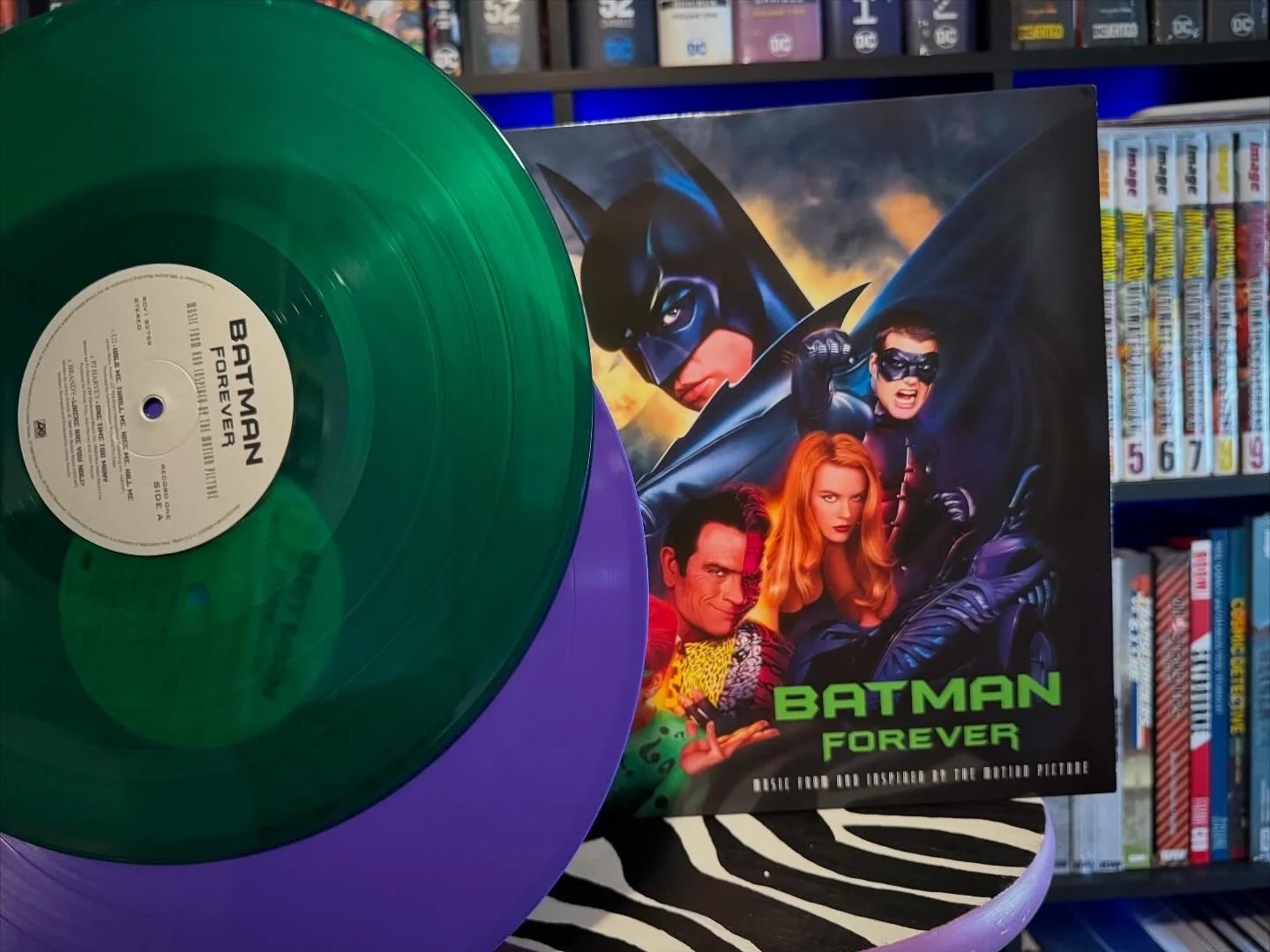
BATMAN FOREVER splattered neon paint across the public consciousness 30 years ago. Despite how many fandoms, executives, and creative teams have tried to scrub it out of existence—that paint has left a stain on the characters filmography. But is that a bad thing?
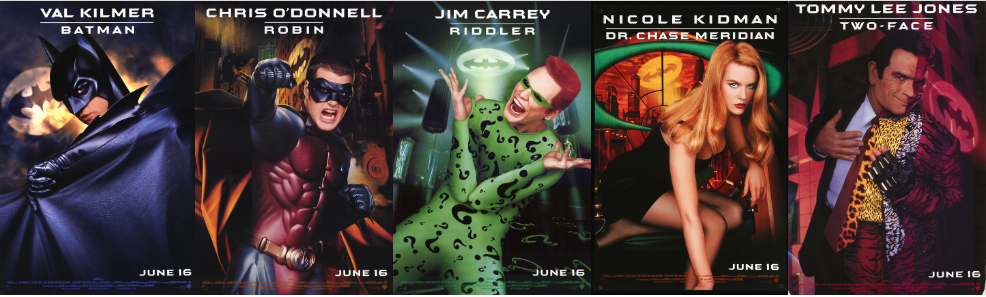
BATMAN FOREVER - June 16, 1996 - Dir: Joel Schumacher
Written by: Lee Batchler, Janet Scott-Batchler, and Akiva Goldsman
Budget: $100M; Gross: $336M Global
Director Joel Schumacher (The Lost Boys, A Time to Kill, Falling Down) and writers Lee Batchler, Janet Scott-Batchler, and Akiva Goldsman, executed one of cinema’s most severe aesthetic whiplashes between sequels ever attempted. BATMAN FOREVER wasn’t just a different direction after BATMAN RETURNS in 1992, but a complete shift in tone, style, and film language. Where Tim Burton relied on gothic architecture, operatic dialogue, and deep shadows, Schumacher opted to put black lights in dark corners, puns in mouths, and make Gotham a megacity populated with giant statues the size of Lady Liberty, placed sporadically between skyscrapers. This wasn’t a stand in for New York or Chicago, but a wholly fictional landscape where the ridiculousness could get waved off as a typical Wednesday.
Gone was the focus on orphan tragedy, to be replaced by an almost Shakespearian-level parody of tragicomedy, light on the tragic, of course. If you think that’s a weird comparison, I present the film’s villains as exhibit A & B whose primary dialogue is to orate their thoughts and motivations to an audience that they know is there, but never quite address directly.
Inspired by the 1966 television show, and influenced by the studio’s desire to deliver a more toy-friendly film, Schumacher seemingly relished the opportunity to wash the Dark Knight in bright colors and self-awareness. The film’s principal cast exhibited no confusion about the tone of the film, all showing up to party (save for the rumored friction between Tommy Lee Jones and Jim Carrey). Val Kilmer evolved Michael Keaton’s portrayal of Batman/Bruce Wayne from aloof billionaire and monotone vigilante to charming playboy and comforting crusader. It was a shift in character that was required to service the film’s overall structure. The awkward pauses for contemplation were replaced with schoolboy charisma via the school of Adam West. In any other film, it would stand out as vibrant, but in FOREVER, it’s a performance that serves as a baseline straight man amongst a sea of cliches.
About that cast: The breathy seductress-slash-*checks notes* criminal psychologist Dr. Chase Meridian, played by Nicole Kidman with the subtly of a film noir trope, is juxtaposed against the always exacerbated (and panting) Dick Grayson, portrayed by Chris O’Donnell with such a comically broad rebellious streak that it’s difficult to remember that he witnessed his parents die one scene earlier. This is a film that takes the time to show you Grayson’s acrobatic prowess via hanging his laundry in the most impractical way possible. To call the entire endeavor “extra” is an understatement.
Jim Carrey is harnessing Frank Gorshin on methamphetamines to portray Edward Nygma/The Riddler and it’s a performance that only gets bigger, especially when it’s paired with Tommy Lee Jones’ Harvey Dent/Two-Face. The two simply get in a war of escalation, with the only respite from their antics being scene transitions. No wonder Two-Face’s literal arm candy henchwomen (Sugar and Spice, played by Drew Barrymore and Debi Mazar) have little to no impact on the plot—there’s zero room for them to speak, let alone breathe with Eddie and Harvey taking up every atom of oxygen in the scene.
BATMAN FOREVER also introduces the franchise to the needle-drop. One of the most lasting marks that this movie has had on the shared culture is every karaoke boy, girl, and enbie belting out “Kiss from a Rose” by Seal for the decades to follow. Sure, BATMAN ’89 had a Prince album, but the BATMAN FOREVER soundtrack hit at the peak of MTV’s power and was curated to reach every demographic of audiophile. U2, Seal, Method Man, Brandy, The Flaming Lips, Nick Cave, Massive Attack, Mazzy Star, and The Offspring? The music supervisor was either cooking pre-algorithm, or micro-dosed a little too close to the sun to come up with this grouping of artists. It feels like the only bands missing are Bone Thugs and Smashing Pumpkins.
*passed a piece of paper*
Oh, um. It has com to my attention that Bone Thugs n’ Harmony as well as The Smashing Pumpkins are featured on the BATMAN & ROBIN (1997) soundtrack. Fascinating.
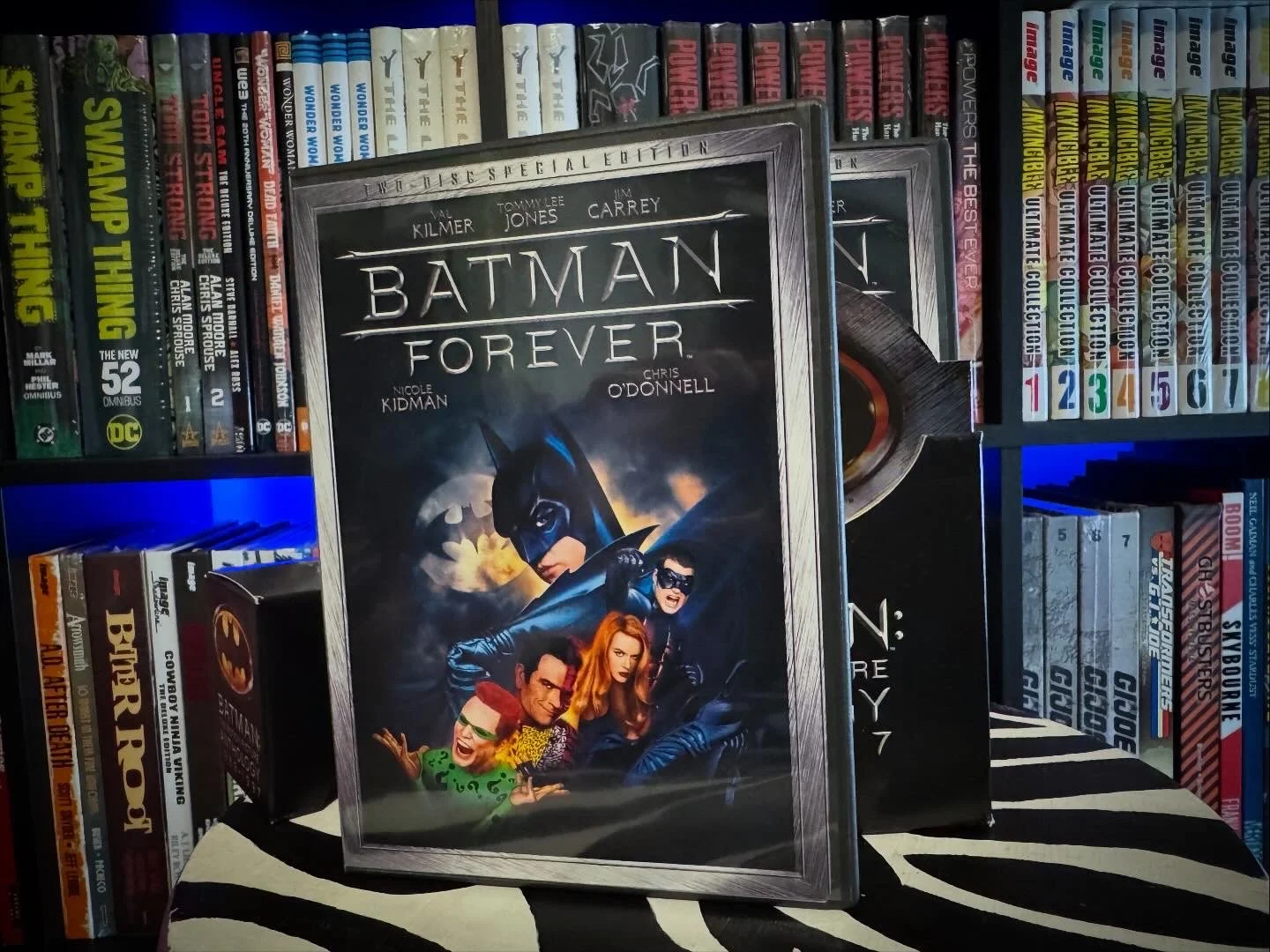
Look. This is not a “good” movie, but it’s defiantly an earnest one. In an increasingly cynical world, that’s kind of a beautiful thing. BATMAN FOREVER both caters to the lowest form of commercial filmmaking (story points driven by toy sales, fast food tie ins, cringe jokes, and a broad, unchallenging narrative), but does so with the bombastic creative energy of a filmmaker with passion and vision. For the last 30 years it has taken every beating imaginable, but never shied away from what it is and what it means to a lot of fans.
BATMAN FOREVER was not the movie anyone was expecting, or even wanted, but is a movie that’s become more and more pronounced over time—even more so than nipples on the bat suit.
I leave you with the wise, immortal words, first uttered into existence in early 1995 —Courage now. Truth always. Batman… Forever.
And ever. And ever after. #ReleasetheSchumacherCut